Today, we are introducing Hydrogen-1.0, a scientific model built by post-training GLM-5.3 on domain data from chemistry, materials science, and life sciences, together with records and agent trajectories from our own laboratories.
Large language models are beginning to contribute to scientific discovery. OpenAI has reported a proof concerning finite-time singularities in the forced Navier–Stokes equations, produced by AI agents and accompanied by a Lean formalization. Anthropic has identified an enzyme system with CRISPR-like repeats through genomic analysis and laboratory investigation. These advances show how models can help researchers explore difficult problems, notice unfamiliar patterns, and develop ideas that can be checked through mathematics or experiments.
Yet the models behind these examples are proprietary: their discovery capabilities are not available as open weights, and some are not even accessible through a public API. Establishing comparable, independently reproducible scientific discovery with general-purpose open-weight models remains an important aspect. A capable open model would let researchers inspect and adapt the underlying system, test its methods, and build on shared improvements.
The shared scientific progress helps link hypotheses to evidence. Simulations and laboratory experiments provide feedback on model hypotheses. Records of hypotheses, actions, observations and revisions—including failed attempts and unexpected results—allow models to learn how research decisions lead to outcomes. Preserving this context connects general model capabilities to the demands of scientific work.
Hydrogen-1.0 brings this approach to chemistry, materials science and life sciences. It learns from scientific knowledge, laboratory records and discovery trajectories to connect reasoning with the decisions involved in research. Our aim is an open-weight model that helps scientists formulate questions, design informative experiments and use the resulting evidence to guide further discovery.
Scientific reasoning from an open foundation
Hydrogen-1.0 outperforms GPT-6-Astra on FrontierScience-Research (FSR) and improves over GLM-5.3 on GPQA-Diamonds in our evaluations, roughly matching the open frontier model Kimi-K3. The benchmarks test scientific knowledge and reasoning on challenging scientific questions. Gains across both tests support scientific post-training of capable open-weight models as a foundation for practical research.
Figure 1. Scientific reasoning after domain post-training. Performance versus average output-side API cost for Hydrogen-1.0, its starting checkpoint GLM-5.3, and reference models Kimi K3 and GPT-6 Astra on FrontierScience Research (pass rate) and GPQA Diamond (accuracy). Costs use standard USD output-token rates, including reasoning; Hydrogen-1.0 uses GLM-5.3 pricing. Input and judge costs are excluded. Higher scores indicate better performance.
Scientific scenarios in practice
General scientific knowledge becomes useful when a model can make a correct prediction or decision in a specific research setting. Our internal evaluations compare Hydrogen-1.0 and GPT-6-Astra on scientific computing, one-step forward reaction prediction, and NMR structure elucidation, scenarios our internal research team frequently encounters.
In these evaluations, Hydrogen-1.0 scores higher on scientific computing and forward reactions than GPT-6 Astra at each of the three thinking settings. Compared with Astra at maximum thinking, its leads are 5.13 and 4.76 percentage points, respectively. Astra at maximum thinking still scores higher on NMR structure elucidation by 3.33 points. The figure compares these scores with the average API cost of answering a question. Differences in absolute scores across tasks reflect the difficulty of the internal cases and should not be read as direct comparisons of model capability.
Figure 2. Performance and cost across research tasks. Mean response score versus average API cost per question for Hydrogen-1.0 and GPT-6 Astra at low, high, and maximum thinking. Costs use standard USD input and output rates, including reasoning and recorded cache discounts; Hydrogen-1.0 uses GLM-5.3 pricing. Higher scores indicate better performance. Some questions are adapted from our previous work, Scientific Discovery Evaluation (SDE).
Writing, debugging, and running a polymer MD workflow
Hydrogen-1.0 turns a materials question into an executable simulation workflow. In this example, it writes Python to build a polyethylene melt, runs GROMACS, detects and repairs a topology error, and restarts the simulation. It then explores the corrected 40 ns trajectory and its density, molecular packing, diffusion, and chain dimensions.
Growing a reaction network
Scientific exploration rarely ends with a single product. Hydrogen-1.0 explores an Ireland–Claisen (IC) rearrangement network, generating 27 molecular structures through 30 plausible reactions. The network includes competing branches and return paths around a five-step sequence of Cope and Claisen rearrangements and silyl shifts. In the selected comparison, the main route has a lower electronic barrier than its displayed alternative at each step, while some alternatives have similar barriers. Mapping these possibilities together helps researchers locate potential bottlenecks, compare competing routes, and prioritize further investigation.
Identifying structures from an NMR spectrum
A reaction network proposes what could form, while a measured spectrum helps establish what the sample contains. Here, Hydrogen-1.0 starts with seven possible monoformylation products of 2-bromonaphthalene and works through the supplied ¹H NMR trace, inspecting the downfield signals and crowded aromatic region before assessing the candidate structures.
Learning from the whole experiment
A laboratory record is most informative when the intent, procedure, observations, and outcome remain connected. Our electronic laboratory notebook (ELN) records, backed by Mira’s agentic documentation, preserve context across this life cycle: what a scientist wanted to learn, how the experiment was performed, what happened, and what to investigate next.
Learning from these records improves Hydrogen-1.0's ability to turn a one-sentence intent into an experimental plan, generate precise protocols, and interpret results. The comparison below shows Hydrogen-1.0’s advantage in planning laboratory experiments.
Figure 3. Experiment design and planning. Mean rubric score (/10) versus average estimated output API cost per problem for Hydrogen-1.0 and Kimi-K3 on 117 shared questions. Costs use the same USD output-token rates as Figure 1, including reasoning; input and judge costs are excluded. Both models use a shared tokenizer estimate. GPT-6-Astra and Opus-5.5 are omitted because they rejected more than 50% of requests in this evaluation. Higher scores indicate better performance.
From a research goal to a laboratory run, via lab compilation
As scientific agents move from proposing experiments to running them, their protocols need to become testable instructions for a particular lab. Equipment limits, tool states, and action order all affect whether a plan can run. Lab compilation checks these requirements in a virtual environment, giving the agent a chance to catch errors, repair its instructions, and retry before committing laboratory resources.
Hydrogen-1.0 writes a JSON protocol for a 12-vial Suzuki coupling study. The virtual rehearsal catches an attempt to aspirate without a fresh tip. Hydrogen-1.0 fixes the action order and successfully compiles the revised protocol before final execution and analysis handoff. The local checks cover station capabilities, dependencies, and action prerequisites. Catching these errors before execution helps address safety concerns about greater AI autonomy in the laboratory.
Learning to discover new materials
Open-ended discovery requires choosing what to try when the answer is unknown. Scientists form hypotheses about a material, choose how to synthesize or evaluate it, and revise their expectations after seeing the result. We train Hydrogen-1.0 on explicit discovery trajectories to learn these connections between choices, properties, synthesis strategies, and outcomes.
Turning trajectories into scientific intuition
We study whether this learning improves decisions on held-out material families: which candidate to explore, which synthesis path to consider, and which observation would be most informative. In transition metal complex (TMC) design, we examine how effectively a model uses successive evaluations to find complexes with a larger HOMO–LUMO gap.
In this comparison, each model starts from the same initial population and recommends new TMCs in each of five rounds. Then their paths diverge. Each model receives only the results of its own recommendations as feedback for the next round, keeping the evaluation histories independent. By round five, the mean best-so-far gap reaches 4.318 eV for Hydrogen-1.0, compared with 3.689 eV for GPT-6-Astra and 3.353 eV for Kimi-K3. These results demonstrate the promise of finding materials with desired properties in fewer attempts.
How we train Hydrogen-1.0
Our training pipeline combines supervised fine-tuning (SFT) and reinforcement learning (RL) to help Hydrogen-1.0 learn from scientific work. We draw on domain data, task-specific feedback from our scientists, laboratory records, and complete discovery trajectories. SFT provides worked examples of reasoning, experiment planning, protocol design, and results analysis. RL trains the model to make better decisions using feedback on research outcomes.
Domain knowledge
Chemistry, materials science, and life sciences data build the scientific foundation.
Research scenarios
Task-specific feedback from our scientists sharpens decisions on research problems.
Laboratory records
Full-cycle records let the model learn how experiments unfold, not just their outcomes.
Discovery trajectories
Sequences of choices and feedback teach the model how to explore under uncertainty.
Full-model MoE post-training places different demands on the same hardware: optimizer state consumes memory during updates, long sequences retain activations, and a few lengthy RL responses can delay a rollout round. Building on Megatron and SGLang, our infrastructure adapts parallel execution and state placement across NVIDIA CUDA and AMD ROCm to support both SFT and RL.
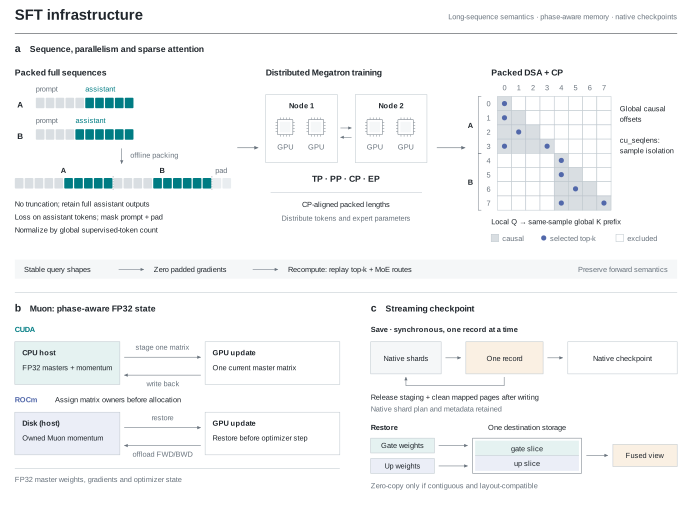
Figure 4. Distributed infrastructure for full-model supervised fine-tuning. Complete sequences are packed for Megatron training with tensor, pipeline, context and expert parallelism. The schematic shows causal sparse attention within each sample, optimizer state placement across CUDA and ROCm, and checkpoint records written individually and restored into shared storage. Hardware layouts and memory sizes are schematic.
Long-sequence training within memory limits
Preserving long-sequence supervision.
Offline packing retains complete reasoning examples without truncation. We supervise the full assistant output, mask prompt and padding positions, and normalize loss by the global number of supervised tokens. Sequence boundaries travel through cu_seqlens, with packed lengths aligned for context parallelism. Assistant turn endings are handled separately from tokenizer EOS and PAD tokens to avoid duplicate terminal tokens.
Keeping sparse attention causal across shards.
Packed sequences require care when dynamic sparse attention (DSA) selects keys across context-parallel shards. We supply global causal offsets and enforce each sample's boundaries during Top-k selection, so a local query sees only its own sample's causal key prefix. Stable query shapes and zeroed gradients at padded positions address backward graph recompilation and padding-related numerical failures while retaining cuDNN and FlashMLA execution paths on CUDA. For recipes using full recomputation, we replay the selected sparse-attention indices and MoE routing state to preserve the original forward computation.
Moving Muon state with the computation phase.
We retain FP32 master weights, gradients, and optimizer state while managing their placement separately for each backend. On CUDA, masters and momentum remain on CPU; the current master matrix is staged on GPU for its update and then written back, bounding temporary optimizer memory. On ROCm, matrix ownership is resolved across ranks before master-weight allocation. Owned Muon momentum is offloaded to disk during forward and backward computation and restored before updates, leaving GPU memory available for long-sequence activations.
Checkpointing within host-memory limits.
Our ROCm path writes synchronously within each process, transferring and serializing one record at a time while retaining native shard planning and metadata. Staging storage and clean mapped pages are reclaimed after writing, limiting temporary host-memory growth. On restoration, the gate and up weights of a fused MoE projection load directly into separate slices of one shared destination allocation. Contiguous, layout-compatible slices can then form a fused view without an additional concatenation allocation.
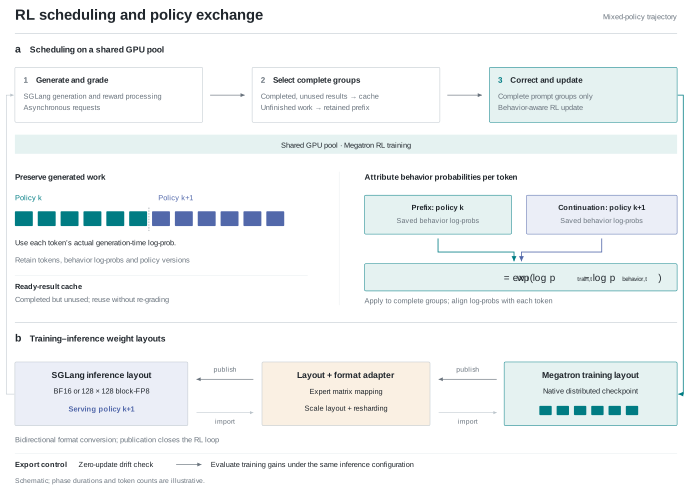
Figure 5. Resumable reinforcement learning on shared GPUs. Complete prompt groups enter training; unfinished responses retain their prefixes for a later rollout round. Token colours distinguish generating policies, and each token retains its original behaviour log-probability. Updated weights pass through a layout adapter before generation resumes. Two rounds are illustrated; durations and token counts are schematic.
Resumable rollouts and policy exchange
Alternating rollout and training
For RL, the shared GPU pool alternates between rollout and training. Generation and grading run asynchronously within the rollout workflow, and training batches contain complete prompt groups. Once enough complete groups are available, unfinished responses retain their generated prefixes for continuation in a later round. Completed results awaiting selection remain cached, avoiding repeated generation and grading.
Correcting for the policy that generated each token.
A resumed response may span several policy versions. Each token retains its actual generation-time behavior log-probability: an older prefix keeps its original values, while the continuation records those of its generating policy. Importance correction uses this token-aligned behavior information in the selected policy-optimization objective. Unfinished prefixes remain outside the training batch until their prompt groups are complete.
Controlling the training–inference boundary.
Training and inference use different weight layouts and precision formats. A bidirectional adapter connects native distributed checkpoints with BF16 and 128×128 blockwise FP8 inference weights, including backend-specific expert mappings, scale layouts, and resharding. Before attributing an evaluation change to training, we first measure export and quantization drift with zero gradient updates. We then evaluate training under the same inference configuration.
Availability
Hydrogen-1.0 is available through four access routes:
- Hugging Face — download the open weights.
- ModelScope — download the open weights.
- NeuroSpark — access the model directly through an API.
- Mira — use Hydrogen-1.0 in our AI Scientist.
Toward continually growing scientific intelligence
Hydrogen-1.0 connects domain knowledge and reasoning, concrete research scenarios, experimental workflows, and finally, new materials discovery. Our results suggest that the scientific data we choose and the feedback we preserve can substantially extend what a model is able to do in science.
Our work on materials discovery makes this connection concrete. Reinforcement learning on complete agent trajectories toward specific discovery targets improves the model's ability to further pursue those targets. A trajectory connects the initial property objective to candidate selection, synthesis path design, evaluation, interpretation, and the choice of what to try next. Training on this sequence gives the model feedback on how its decisions contribute to progress over an entire discovery campaign. Unsuccessful candidates and revised hypotheses become part of the experience it can learn from.
This approach gives us a way to develop scientific judgment and, even intuition, over longer horizons: which candidates deserve investigation, which observations should change a hypothesis, and how to redirect a search when a promising approach fails. The next challenge is to extend what the model learns across discovery targets and material families, so that experience from one campaign improves its approach to the next.
Science is an open-ended endeavor in which AI can explore and create value indefinitely. Every discovery reveals new questions, and every advance in experimental capability makes new phenomena accessible. As AI helps push this frontier outward, the knowledge and methods a model needs will continue to change. A model trained on today's scientific record must be able to learn from tomorrow's observations, including discoveries it helped make. Continuing progress therefore requires a learning process that can grow alongside science itself.
We worked with UniPat and Mind Lab to build data, training pipeline, and infrastructure, and with NeuroSpark to build the training infrastructure. We welcome collaboration with the open-model community to build better scientific models and help accelerate scientific discovery to tackle social challenges that AI itself introduces in this rapidly changing world.
Building Hydrogen-1.0 is our path toward that goal.